Chess basics
Chess Board Setup: How to Set Up a Chess Board Step by Step
To set up a chess board, turn it so each player has a light square in the bottom-right corner. Put the rooks in the corners, the knights next to them, then the bishops. The queen goes on the remaining square of her own color (white queen on d1, black queen on d8) and the king on the last square (e1 and e8). Fill the second rank with pawns. White moves first.
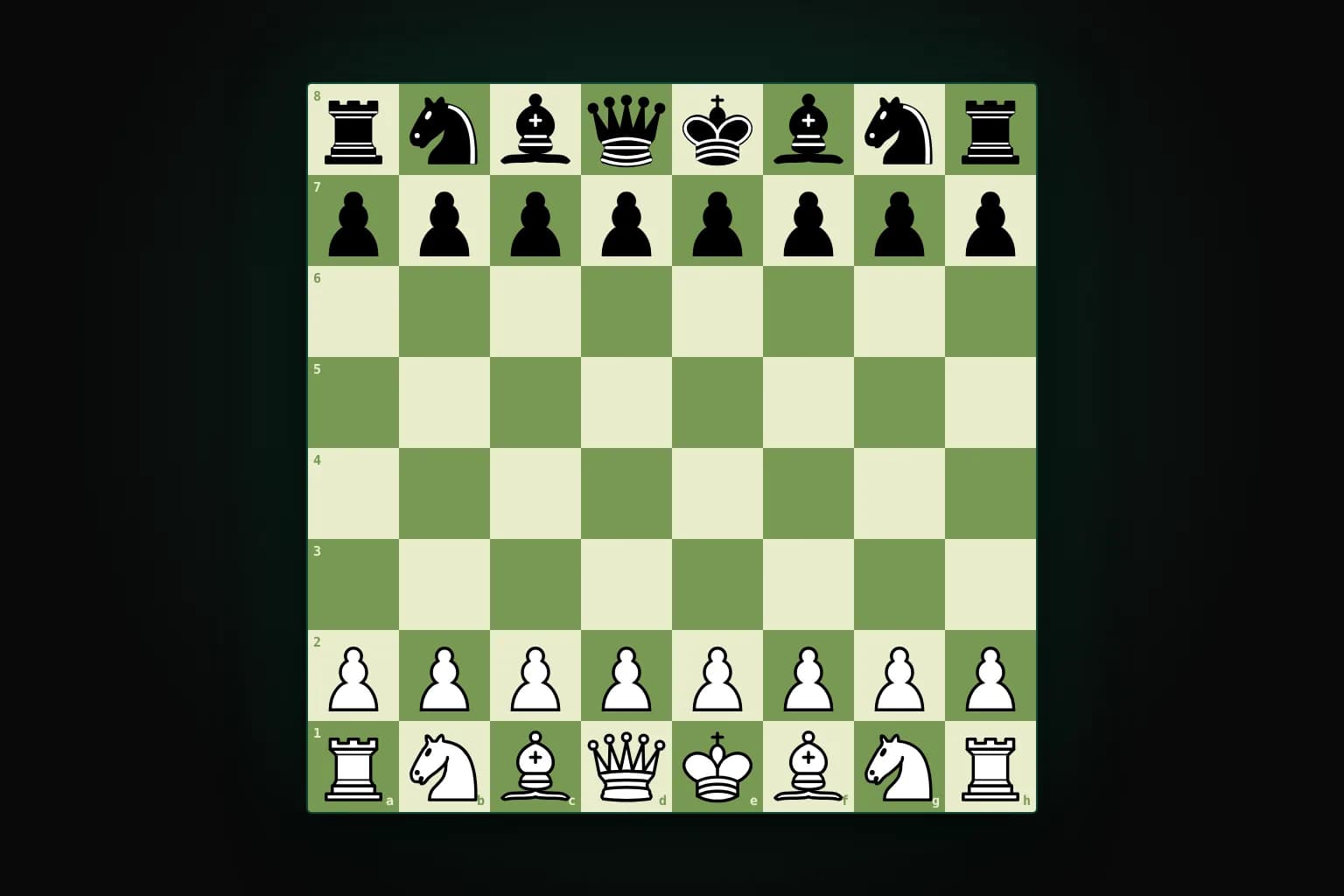
Chess board setup in 30 seconds
- “Light on the right”: the corner square on each player’s right is light (h1 for White, a8 for Black).
- Back rank from the corners inward: rook, knight, bishop, then queen and king in the middle.
- “Queen on her color”: the white queen starts on a light square (d1), the black queen on a dark one (d8).
- The kings face each other on the e-file, the queens on the d-file.
- Eight pawns on each player’s second rank: rank 2 for White, rank 7 for Black. White moves first.
What you need: the board and the 32 pieces
A chess board has 64 squares in an 8×8 grid, alternating light and dark. Each player starts with 16 pieces of one color, White or Black: one king, one queen, two rooks, two bishops, two knights and eight pawns.
The vertical columns are called files and are lettered a to h from White’s left. The horizontal rows are ranks, numbered 1 to 8 from White’s side. Every square has a name, such as e1 or d8, which makes the setup easy to describe and check.
| Piece | Per player | White starts on | Black starts on |
|---|---|---|---|
| Rook | 2 | a1, h1 | a8, h8 |
| Knight | 2 | b1, g1 | b8, g8 |
| Bishop | 2 | c1, f1 | c8, f8 |
| Queen | 1 | d1 | d8 |
| King | 1 | e1 | e8 |
| Pawn | 8 | a2 to h2 | a7 to h7 |
Step 1: Place the board with a light square on the right
Turn the board so that the corner square closest to each player’s right hand is light. The usual memory aid is “light on the right”. It is the most common setup mistake, and the official FIDE Laws of Chess spell it out: the near right-hand corner square must be white.
If your board has letters and numbers printed on the edge, White sits on the side of ranks 1 and 2, and the a-file is on White’s left.
Step 2: Rooks go in the corners
Put the two rooks, the pieces shaped like castle towers, on the four corner squares: White on a1 and h1, Black on a8 and h8.
Step 3: Knights go next to the rooks
The knights, shaped like horses, stand right next to the rooks: b1 and g1 for White, b8 and g8 for Black. Point the horse heads forward if you like; it has no effect on the game, but it looks tidy.
Step 4: Bishops go next to the knights
The bishops, the tall pieces with a slit in the top, go next to the knights: c1 and f1 for White, c8 and f8 for Black. Each side ends up with one bishop on a light square and one on a dark square, and they keep that color for the whole game.
Step 5: The queen goes on her own color
Two squares are left in the middle of each back rank. The queen takes the one that matches her color: the white queen goes on the light square d1, the black queen on the dark square d8. Remember “queen on her color”.
Done correctly, the two queens face each other on the d-file. Seen from White’s side, both queens are on the left of their king.
Step 6: The king takes the last square
The king, the tallest piece with a cross on top, goes on the last empty square of the back rank: e1 for White, e8 for Black. The two kings face each other on the e-file.
Step 7: Pawns fill the second rank
Place the eight pawns on the rank in front of the other pieces: a2 to h2 for White, a7 to h7 for Black. The board is now in the starting position, and White makes the first move.
Common chess board setup mistakes
Check these before the first move, especially with a new player or an unfamiliar set:
- The board is turned a quarter: a dark square sits in the right-hand corner. Turn it 90 degrees.
- King and queen are swapped. The white queen must be on a light square and the black queen on a dark one, facing each other.
- Knights and bishops are swapped. The order from the corner is rook, knight, bishop.
- The two sides are not mirrored: a white piece should face the same black piece across the board on every file.
- A pawn is missing, or a piece from another set has slipped in. Count 8 pawns and 8 pieces per side.
In an official game the rules depend on which mistake was made. Under article 7 of the FIDE Laws of Chess, a game started with the pieces in the wrong starting position is cancelled and replayed. A game played on a board turned the wrong way continues, but the position is moved to a correctly placed board.
Who moves first, and how to choose colors
White always moves first. In a casual game, players often pick colors by chance: one player hides a white pawn in one hand and a black pawn in the other, and the opponent picks a hand. In tournaments, the pairings decide who plays White, and players usually alternate colors from round to round.
If you are new to the game, the first few moves are where the setup turns into a plan. The most played first moves are 1.e4 and 1.d4, which open lines for the queen and bishops.
The starting position in chess notation (FEN)
Chess software describes a position with a one-line code called FEN (Forsyth–Edwards Notation). The starting position is: rnbqkbnr/pppppppp/8/8/8/8/PPPPPPPP/RNBQKBNR w KQkq - 0 1.
The first part lists the board rank by rank, from rank 8 down to rank 1. Lowercase letters are black pieces, uppercase are white, and numbers count empty squares: r rook, n knight, b bishop, q queen, k king, p pawn. Then come the side to move (w), the castling rights (KQkq), the en passant square (- for none) and two move counters.
Pasting a FEN into an analysis board sets up a position in one step. You can also build one piece by piece with a board editor, for example to copy a puzzle from a book or a position from your own game, and ask Stockfish for the best move.
Chess960 setup: a different back rank
Chess960, also called Fischer Random, uses the same board and pawns, but the pieces on the back rank are shuffled before the game. Three rules keep it playable: the bishops stand on squares of opposite colors, the king stands somewhere between the two rooks, and Black’s pieces mirror White’s. That gives 960 possible starting positions, including the normal one.
Frequently asked questions
How do you set up a chess board?
Place the board with a light square in each player’s bottom-right corner. Put the rooks in the corners, the knights next to them, then the bishops. The queen goes on her own color (d1 for White, d8 for Black), the king on the last square (e1 and e8), and the eight pawns on the second rank.
Does the queen go on the left or the right?
The queen goes on her own color, which puts her on the d-file. Seen from White’s side, both queens are to the left of their king. From Black’s seat, the black queen is on the right of the black king.
Which way does a chess board go?
The board is placed so that the corner square on each player’s right is light. The usual way to remember it is “light on the right”.
Where do the king and queen go in chess?
In the middle of the back rank. White: queen on d1, king on e1. Black: queen on d8, king on e8. The queens face each other, and so do the kings.
Does the knight or the bishop go next to the rook?
The knight. The back rank from the corner is rook, knight, bishop, then queen and king in the middle, then bishop, knight and rook.
How many pieces are on a chess board at the start?
32 pieces: 16 per player, made of 8 pawns, 2 rooks, 2 knights, 2 bishops, 1 queen and 1 king. They fill the first two and last two ranks, leaving 32 empty squares in the middle.
Who goes first in chess?
White always makes the first move. Players usually draw lots for colors, for example by guessing which hand hides a white pawn.
Sources & further reading
The starting position, board orientation and the rules for setup errors follow the FIDE Laws of Chess (articles 2 and 7). Diagrams by ChessHunter.