Game analysis
How to Use a Chess Engine to Improve Your Chess
To use a chess engine for improvement, review a completed game yourself, choose a decision to investigate, and compare your idea with the engine’s strongest reply. Then save the lesson in words you can use during your next game.

Your preparation checklist
- Write down what you expected before revealing the engine’s recommendation.
- Follow a variation until you can explain why your idea works or fails.
- Compare candidate moves instead of memorizing a single answer.
- Save one instructive position and revisit it with the suggestions hidden.
Start with a chess question you actually need answered
You finish a game, open the analysis board, and discover that your promising attack was losing. The computer recommends a quiet rook move. You click through the variation, understand very little, and start another game. What can you take away from that review?
Give the analysis a specific job. Perhaps you need to know whether a pawn capture was safe, whether exchanging queens helped, or when your attack stopped working. A narrow question gives you a reason to explore the suggested moves.
The routine below is an editorial training suggestion. Try it on one of your completed games and adapt it to the time you have. Aim to leave with an explanation you could give another player over a physical board.
How to read a chess engine evaluation
A chess engine searches possible continuations and evaluates positions. On Chess.com’s analysis board, a positive score favors White, a negative score favors Black, and a score close to zero indicates approximate equality. Suggested variations show the continuations behind those assessments.
The number is not a material count. Modern Stockfish evaluations are calibrated using game outcomes, so +1 does not simply mean an extra pawn. Nor does the score tell you your personal chance of winning against your next opponent.
When an evaluation surprises you, inspect the moves. Locate the first response you did not consider and work forward until the consequence becomes clear. A change in the number is a prompt to investigate.
A five-step method for analyzing your chess games
Choose one moment when you felt uncertain. Before switching on suggestions, write down your intended plan, the reply you expected, and another move you considered. “I exchanged bishops because I thought the pawn ending was winning” gives you an assumption to test.
Next, play your candidate move on the analysis board. Examine the engine’s strongest response. Continue until you can identify what your original calculation missed: a defensive exchange, an intermediate check, or a threat against an undefended piece.
Return to the starting position and explore the recommended alternative. Explain what it changes. Perhaps it keeps a defender in place or prepares a pawn break. If your explanation only says “the evaluation is better,” investigate another move or two.
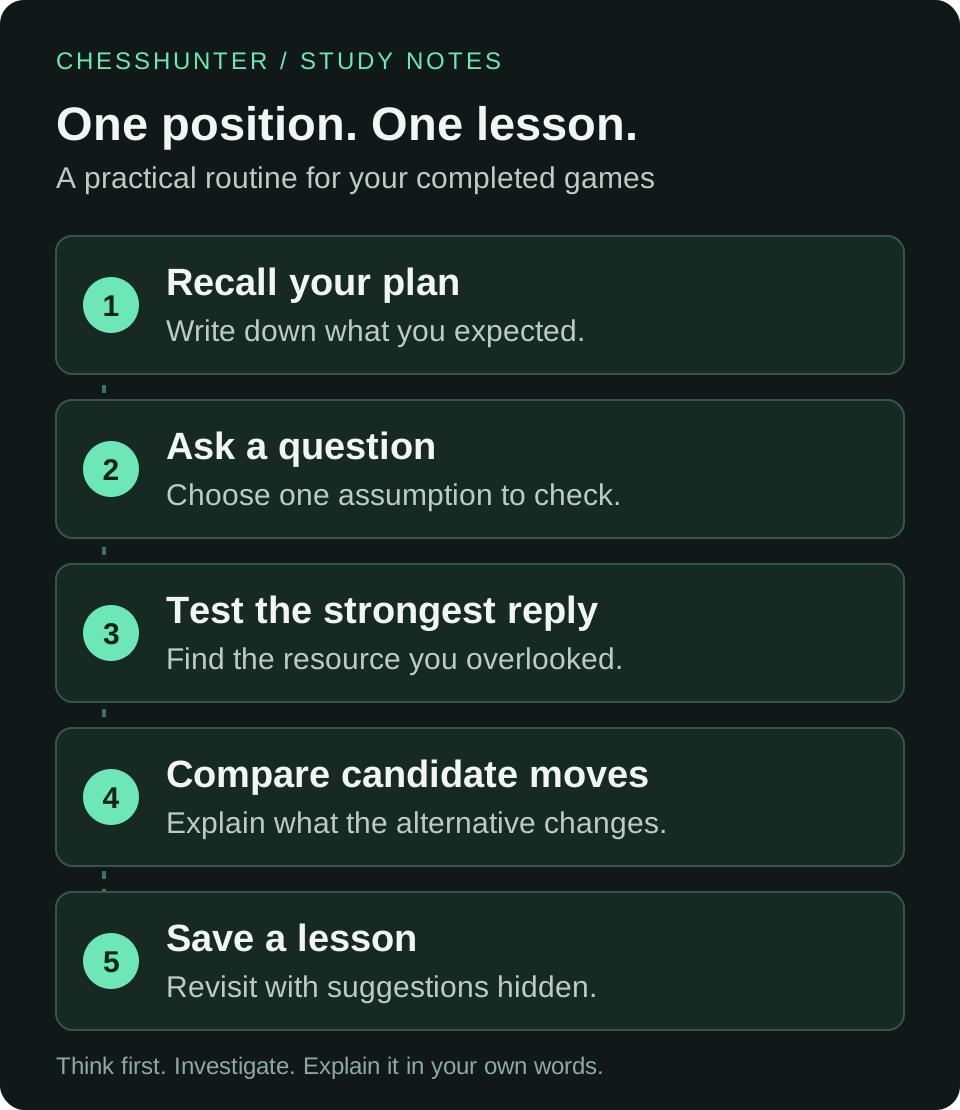
Finally, save a short note and revisit the position later with the suggestions hidden. Try to find the move and explain why your original choice fails. Use the sequence below to keep the review focused.
- Recall: What did I intend, and what reply did I expect?
- Question: Which assumption do I want to check?
- Test: What is the strongest response to my idea?
- Compare: What does the alternative accomplish?
- Remember: What should I notice next time?
Turn a missed tactic into a training exercise
Consider a hypothetical example: you captured a pawn and allowed a knight fork against your king and rook. Recording the engine’s preferred move would tell you what to play in that exact position. A useful study note also captures the assumption that led you astray.
Write three lines: “I wanted to win the loose pawn. I overlooked a forcing reply after my capture. Next time, I will check the opponent’s checks and threats before deciding the pawn is free.” This is a concrete cue to practice.
Build a small collection of positions with the same kind of oversight. Group them by the decision you struggled with: grabbing material, exchanging into an unfamiliar ending, or attacking before completing development. Choose one group for your next review session.
| Decision | Question to investigate | Lesson to record |
|---|---|---|
| Capture a pawn | Which forcing reply follows the capture? | Check what the opponent gains in return. |
| Exchange queens | What changes in the resulting ending? | Evaluate the position after the exchange. |
| Launch an attack | Can the defender trade my key attacking piece? | Identify the defender’s resources. |
Choose engine settings that help you understand
For this routine, start with two or three candidate lines. Compare your move with an alternative, then follow the replies. Add more lines only when you have a specific reason to compare additional choices.
Give the engine more time if its preferred move or evaluation keeps changing. Search depth is a useful indicator, but it does not mean every continuation has been checked equally far: Stockfish shortens some branches and extends others.
When a line feels too difficult, narrow the question. Test the reply that looks natural to you and find out why it succeeds or fails. You can save an unresolved position for another session instead of trying to memorize a long sequence you cannot explain.
Try a 15-minute post-game review
Use the following schedule as a starting point. Select a completed game in which you remember your thought process. Adjust the timing when a position deserves more attention; there is no need to force every review into exactly fifteen minutes.
At the end, write one sentence you want to remember during play. In a later game, check whether you noticed the same feature before moving. That connects the review to a decision you can actually change.
| Time | Task | Keep |
|---|---|---|
| 5 minutes | Replay with engine suggestions hidden. | Two decisions you were unsure about. |
| 7 minutes | Test your ideas and compare the strongest replies. | An explanation of the missed resource. |
| 3 minutes | Write a lesson and save a position. | One exercise to revisit later. |
Use your analysis to prepare for an opponent
You can apply the same questions before a match. Pick a position from your own repertoire that could plausibly arise against the opponent. Write down your intended plan, test the replies, and keep a short explanation of the ideas you need to remember.
Start by finding relevant games and checking the player identity, colors, and time control. Use the available games to decide what deserves attention. A computer assessment of one position is not evidence that an opponent will reach it or mishandle it.
ChessHunter’s preparation guides explain how to find games and compare opening patterns. Combine that research with your position study to choose a familiar plan and a fallback. Keep the limits of the available game sample in your notes.
Frequently asked questions
How should a beginner use a chess engine?
Choose one decision from a completed game. Write down your idea before revealing suggestions, then investigate the strongest reply. Save a short explanation and revisit the position with the answer hidden.
What does +1 mean in a chess engine evaluation?
On Chess.com’s analysis board, +1 favors White. It is not a literal count of extra pawns or a personal winning probability. Use the continuation to investigate the reason for the advantage.
What engine depth should I use to analyze a game?
There is no universal depth that settles every position. Allow more time when the evaluation changes and investigate the suggested replies. Reported depth does not guarantee that every branch was searched equally far.
What if I do not understand the engine’s best move?
Test the move you wanted to play and examine its strongest reply. Then compare the recommended alternative. Try to describe a concrete difference, such as keeping a defender or preventing a threat.
Sources & further reading
Source documentation checked on September 21, 2026. Practical checklists are editorial recommendations; hypothetical examples are labeled in the text.