Fair play
How Chess Cheating Detection Works on Chess.com, Lichess and Over the Board
Chess sites catch cheaters by comparing a player’s moves with what a strong engine would play, then asking whether that level of play is believable for that player, given their rating, their history, their time use and how they behave on the site. Suspicious accounts are flagged by automated models and, for the harder cases, reviewed by people. Over the board, organisers add physical checks and statistical analysis after the event. No single game or accuracy score proves cheating; the evidence is built over many games.
Cheating detection in 30 seconds
- The core signal is statistical: how often a player finds engine moves, and how small their errors are, compared with players of the same rating.
- Platforms add behaviour signals such as time per move, sudden rating jumps and how the account was created and played.
- Chess.com reports closing over 100,000 accounts a month for fair play violations; most closures are automated.
- Lichess publishes its detection tools (Irwin, Kaladin) as open source and refunds rating points to the victims of marked accounts.
- A single high-accuracy game proves nothing. Report suspicions to the platform rather than accusing someone in public.
What counts as cheating in chess?
Online, cheating mostly means getting help during a game: running an engine in another window or on a phone, using a browser extension that shows the best move, or having a stronger player suggest moves. All platforms forbid any outside assistance in rated games, including opening books or tablebases consulted while you play.
Some violations do not involve engines at all. Sandbagging means losing on purpose to lower your rating and then play in weaker sections or prizes. Rating manipulation, or boosting, means farming points from a second account or a friend who resigns. Both break the terms of service and both can lead to an account closure.
Over the board, the rules are the same in spirit: no electronic devices, no outside advice, no notes. Arbiters can inspect players, and serious events delay their live broadcasts so that no one can relay engine moves from the transmission.
The core signal: how often you play like an engine
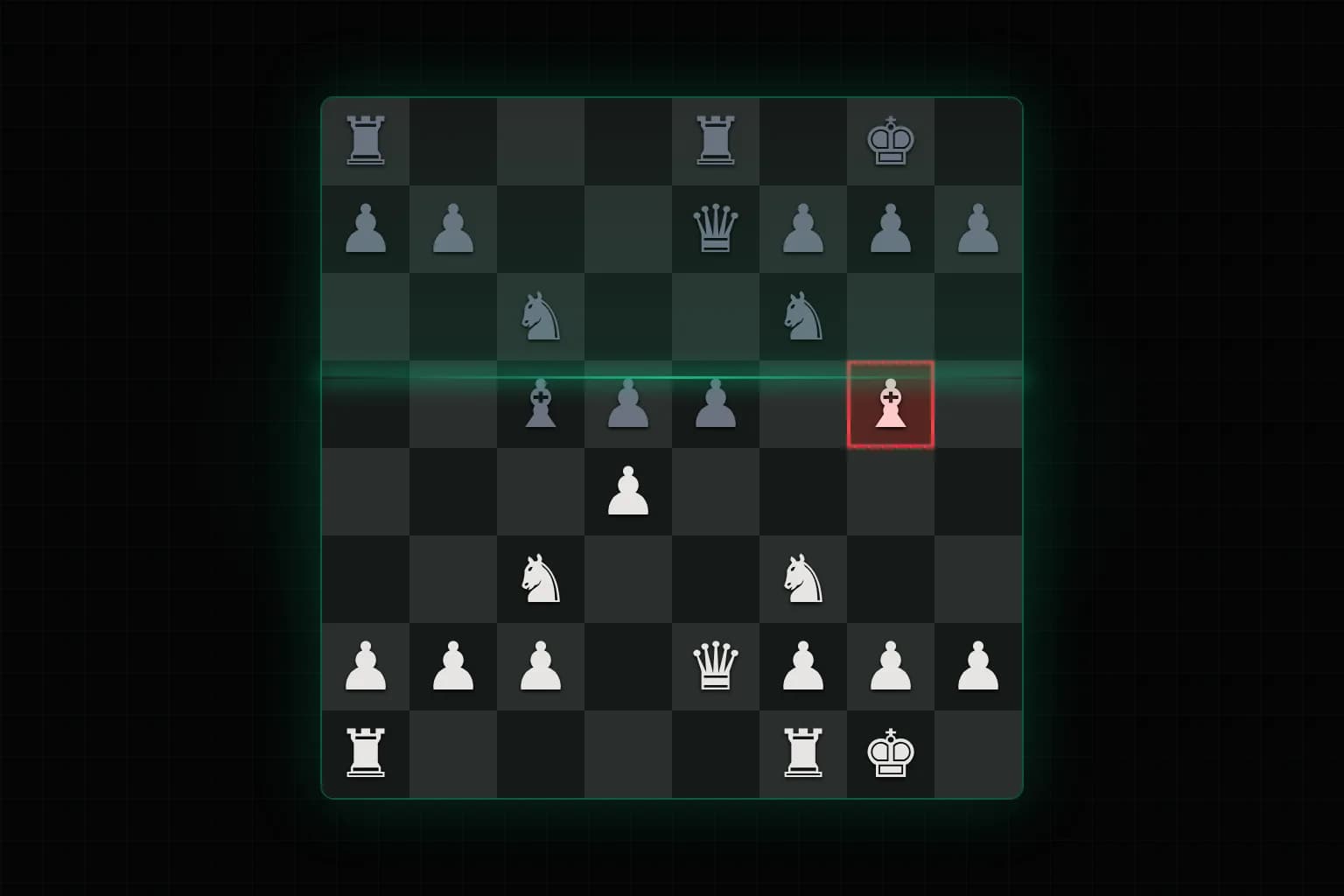
Every detection system starts from the moves. Each position of a game is analysed by an engine, and the system records how often the player chose the engine’s first or second choice and how much evaluation they lost on the other moves. Strong humans also find many engine moves, so the raw number means little on its own.
What matters is the gap between the play and the player. A 1200-rated account that keeps finding the only move in sharp positions, game after game, is far outside what 1200 players do. Statistical models estimate the level a set of games corresponds to and how unlikely that result is for the player’s rating and history. The more games, the stronger the evidence, which is why most closures come after a series of games rather than one.
Detection also looks at which moves are found. Cheaters often play normally in quiet positions and switch on the engine at critical moments. Finding hard, non-obvious moves exactly when the evaluation is on a knife edge is a much stronger signal than matching an engine in simple recaptures.
Behaviour signals: time, ratings and accounts
Moves are not the only data a platform has. Chess.com says its system weighs over 100 gameplay factors, and keeps the exact list confidential so cheaters cannot work around it. The signals that are publicly discussed include:
- Time use: the same few seconds spent on every move, whether the position is trivial or complex, is typical of someone copying moves.
- Rating curve: a sudden, steep climb that does not match the account’s previous results.
- Account history: brand-new accounts that play far above their rating from the first games. Chess.com reports that nearly 40% of the accounts it closes are no more than two weeks old.
- Reports from opponents: they do not ban anyone on their own, but they point reviewers to games worth checking.
None of these signals is proof on its own. Some players are fast in every position, and juniors really do gain hundreds of points in a few months. The value comes from combining them with the move statistics.
How Chess.com catches cheaters
Chess.com runs automated detection on games and has a Fair Play team that reviews the harder cases, especially titled players and prize events. Most closures are automatic: the platform has said that a large majority come from “autoban” conditions that spot clearly inhuman strength or behaviour.
The scale is large. Chess.com has reported closing about 100,000 accounts a month, and its monthly Fair Play updates have since listed figures above 100,000, such as 130,000 closures in March 2026. That is still a small share of active players. A closed account shows the status “Closed: Fair Play” on its profile and in your game history.
If you lost rating to an account closed for fair play, Chess.com can refund those points. Its support page says the reimbursement can take up to seven days, and refunds are not given in every case, for example when the games are too old or the account was closed for another reason.
How Lichess catches cheaters
Lichess combines automated models with a team of volunteer moderators. Two of its models are public: Irwin, a neural network that scores games for engine use, and Kaladin, a newer model that works from the statistics Lichess already computes for each player. Both are open source, which is unusual in anti-cheat work.
When moderators confirm that an account cheated, it is marked for a terms of service violation and its games stop counting. Opponents who lost rating against it get a refund if their rating was not provisional; the refund is capped based on their peak rating and how their rating moved after the game.
Cheating detection over the board
Over-the-board events rely first on prevention: phones and watches handed in, metal detectors and scanners at top events, restrictions on leaving the playing area, and live broadcasts delayed by several minutes.
After the event, games can be analysed statistically, in the same spirit as online detection. FIDE works with fair play experts, most famously the computer scientist Ken Regan, whose model estimates how likely a player’s results are given their rating and the difficulty of the positions they faced. These analyses support an investigation; they are rarely enough on their own to sanction a player.
Why a 95% accuracy game is not proof
Game review tools show an accuracy score after every game, and it is tempting to read a very high score as evidence. It is not. Short games, forced sequences and opponents who blunder early all produce high accuracy for perfectly honest players. Chess.com states that its accuracy reports are not part of its cheat detection.
Detection works on many games and on the hard positions inside them. If you suspect an opponent, use the report button on the game. Accusing someone publicly, in chat or on social media, breaks the rules of most platforms and can be unfair to a player who simply had a great day.
How to check whether you played cheaters
Bans often come weeks or months after the games, so you rarely learn that an opponent was closed. Both platforms show the account status on profiles: Chess.com marks fair play closures, and Lichess marks terms of service violations. Checking hundreds of opponents by hand is not realistic, though.
The ChessHunter cheater check does it for you. Enter your Chess.com or Lichess username and a period; it looks up every opponent you played, lists the ones later banned, your score against them and the rating points recorded on those games, and draws your rating curve with and without them. Keep in mind that part of those points may already have been refunded.
Frequently asked questions
How does Chess.com detect cheaters?
Chess.com compares players’ moves with engine play and weighs over 100 gameplay factors, such as time use and rating history, against what is normal for their rating. Most closures are automated; a Fair Play team reviews harder cases. The exact methods are kept confidential.
How does Lichess detect cheaters?
Lichess uses automated models, including the open-source Irwin and Kaladin, together with volunteer moderators who review reports and flagged accounts. Confirmed cheaters are marked for a terms of service violation.
Do you get your rating back after playing a cheater?
Often, but not always. Chess.com can refund points lost to accounts closed for fair play, within a few days and with some limits. Lichess refunds opponents whose rating was not provisional, with a cap based on their peak rating.
How many accounts does Chess.com ban for cheating?
Chess.com has reported about 100,000 fair play closures a month, and its monthly Fair Play updates have since reported higher figures, for example 130,000 in March 2026.
Is a high accuracy score proof of cheating?
No. Short or forced games often score very high for honest players, and Chess.com says its accuracy reports are not part of its cheat detection. Evidence comes from many games and from hard positions.
How can I see if my opponents were banned?
Open their profile: Chess.com shows “Closed: Fair Play” and Lichess shows a terms of service mark. To check all your opponents at once, use the ChessHunter cheater check.
Sources & further reading
Figures come from Chess.com’s published Fair Play updates and support pages, and from the Lichess FAQ and repositories. Platforms do not publish the details of their detection, so this article describes the methods they have made public.
- Chess.com: Cheating and fair play on Chess.com
- Chess.com: 100,000 accounts closed per month as anti-cheating systems improve
- Chess.com Fair Play team: monthly updates
- Chess.com support: what happens when someone is caught cheating
- Lichess FAQ: fair play and rating refunds
- Kaladin: Lichess’s open-source cheat detection model
- Irwin: Lichess’s first neural network for engine detection
- Wikipedia: Cheating in online chess