Opening study
How to Build a Chess Opening Repertoire You Can Remember
Choose a main first move as White and responses to common first moves as Black. For each branch, record the moves, typical plans and alternatives you actually encounter. Test the positions without notes, use your own games to identify gaps and expand the repertoire gradually.

Your preparation checklist
- Prepare both colors and common opponent replies.
- Record a plan alongside each line.
- Use game examples and engine checks for different purposes.
- Review a small set of positions before adding depth.
Choose a manageable repertoire for both colors
A repertoire is a set of opening decisions, not a promise that every game follows one sequence. As White, choose a first move and cover the replies you face. As Black, prepare answers to 1.e4, 1.d4 and other common first moves in your games.
Start with familiar structures. Keep a short note for each branch: your intended development, an important pawn break and a tactical warning. You can add depth after identifying a recurring problem in your games.
Build one branch on the board
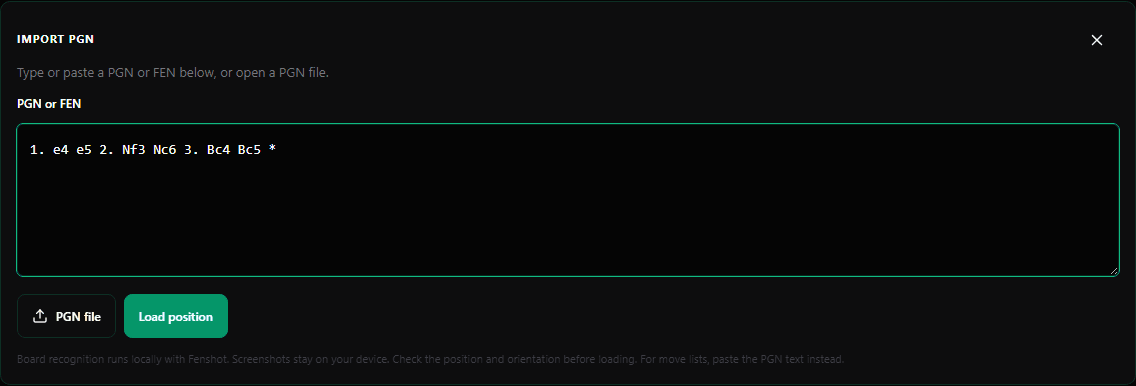
Try the Italian Game starting position: 1.e4 e5 2.Nf3 Nc6 3.Bc4 Bc5. White has developed a knight and bishop; the bishop looks toward f7. Investigate a quiet continuation such as 4.d3, then compare Black’s replies. Explain the purpose of the moves before extending the line.
This example is one branch of a White repertoire. It still needs alternatives such as 3...Nf6 and plans against other first replies, including 1...c5. Cover those branches as separate decisions rather than assuming the Italian appears in every game.
Use opening statistics and example games
Explore continuations at the same position in the master database and in a player’s available repertoire. Check sample sizes and sources before comparing results. Replay an example game to see how the opening leads into a middlegame.
An engine can check whether a specific tactical idea works. Database frequency can tell you what appeared in the sample. Neither substitutes for explaining your own plan.
Save your line and test it without notes
Use Export PGN in Playground to download your study moves. Keep a separate note of the plan if you have not added annotations to the game. On your next study session, reconstruct the critical position and choose a move before consulting the file.
After a training game, record where you left your preparation and whether the problem was memory, understanding or calculation. Add a branch only when it answers a useful question. Repeating a short routine is easier to maintain than collecting lines you never rehearse.
Connect your repertoire to tournament preparation
Repertoire study is an ongoing routine. Before a tournament, refresh the branches you already understand and check logistics. Once pairings are known, research the opponent and select a small number of relevant lines.
Frequently asked questions
How deep should my opening repertoire be?
Prepare until you can explain the resulting position and handle the common alternatives you face. Add depth when your own games reveal a recurring decision you cannot solve.
Can I build a repertoire with ChessHunter Playground?
You can explore positions, compare available opening samples, import a game and export your study moves as PGN. Keep your study files and notes for later review.
Sources & further reading
This study routine is an editorial recommendation. The Italian Game is an example rather than a complete recommended repertoire.